The challenge
The project needed to demonstrate more than a happy-path pipeline. Late, duplicate, malformed, and replayed events had to be handled safely while the resulting analytics stayed explainable.
Monitor GPU health, utilization, and incidents across AI clusters.
Representative synthetic data. The full platform runs locally with Docker, Kafka, Spark, Airflow, dbt, and Grafana.
| Cluster | Active GPUs | Utilization | Max temp | State |
|---|---|---|---|---|
| cluster-a | 24 | 82% | 105.8°C | attention |
| cluster-b | 24 | 81.6% | 111.4°C | attention |
ClusterPulse turns synthetic telemetry into reliable insights for GPU health and capacity planning.
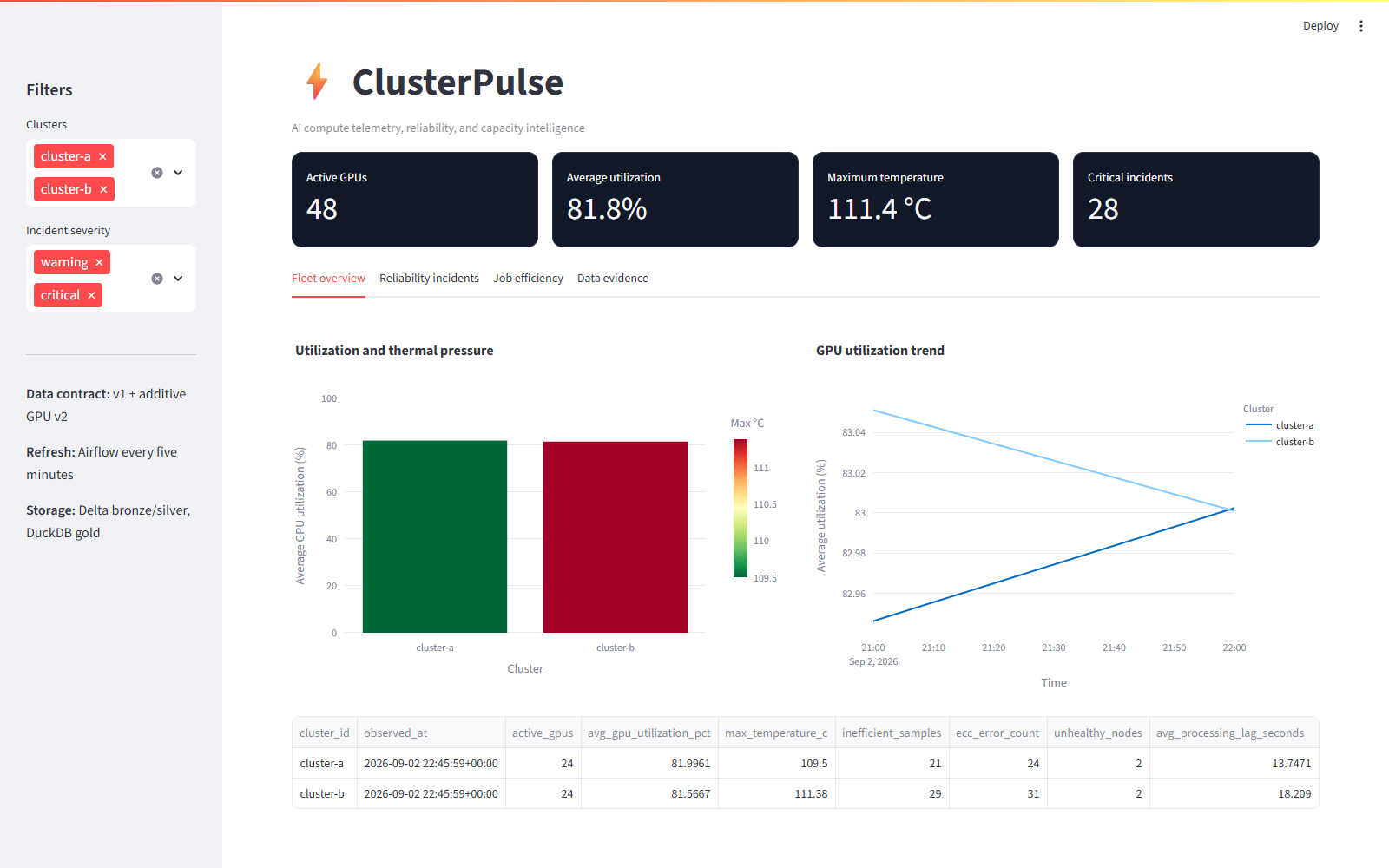
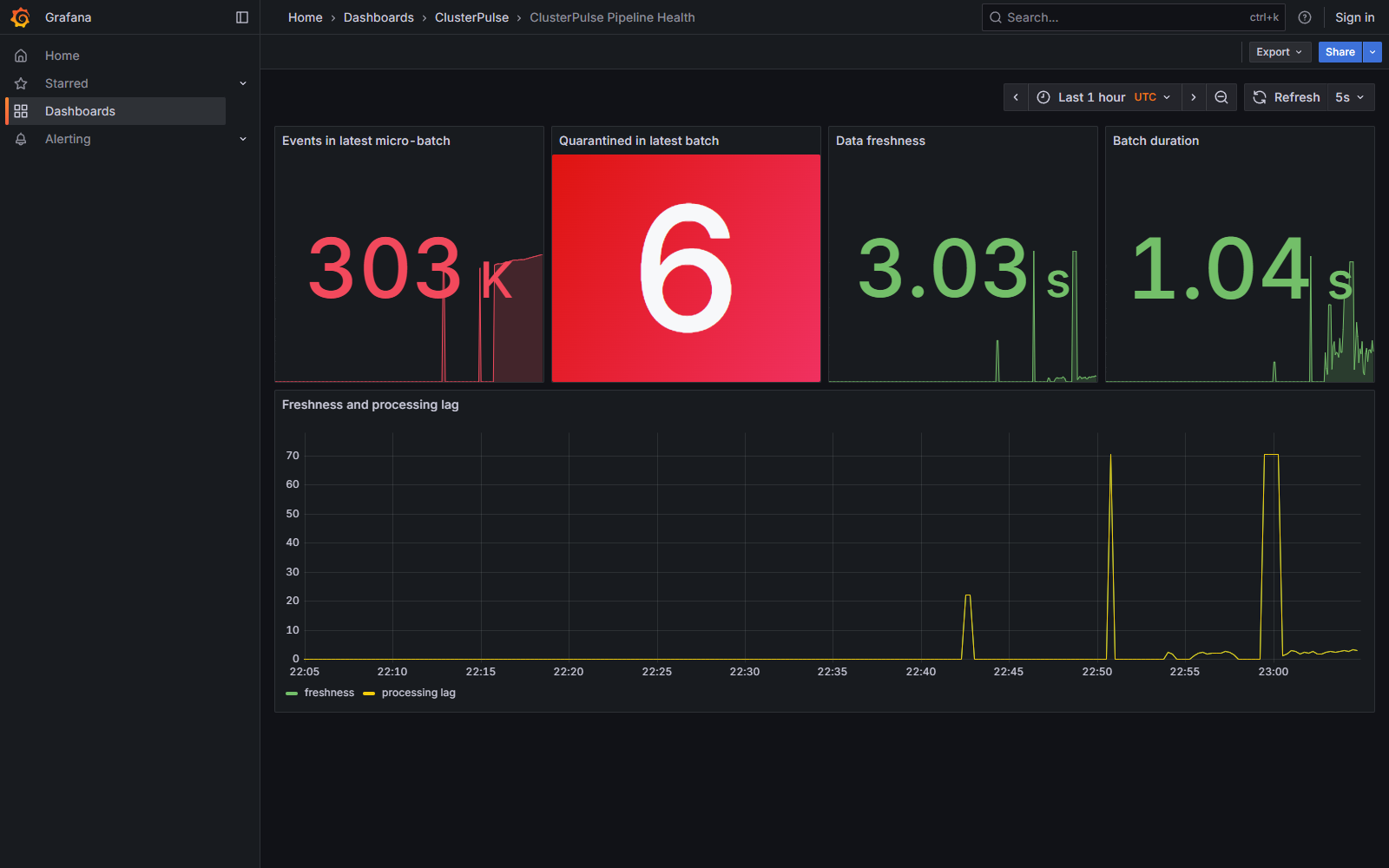
The project needed to demonstrate more than a happy-path pipeline. Late, duplicate, malformed, and replayed events had to be handled safely while the resulting analytics stayed explainable.
The software engineering focus is explicit service boundaries, automated validation, and recovery under failure, with Docker supporting the local environment. Kafka provides the durable event boundary. Spark validates contracts, routes bad records, and maintains independent sink checkpoints. Airflow orchestrates analytics and backfills; dbt builds the dimensional Gold layer.
Repeated runs produced identical trusted totals. Invalid events were quarantined without interrupting processing, and replaying duplicate IDs did not change the Silver record count.
See the implementation, documentation, and decisions.
Explore the repository ↗